
The Biggest 2026 Wedding Trends, Straight From Hyundai India Couture Week
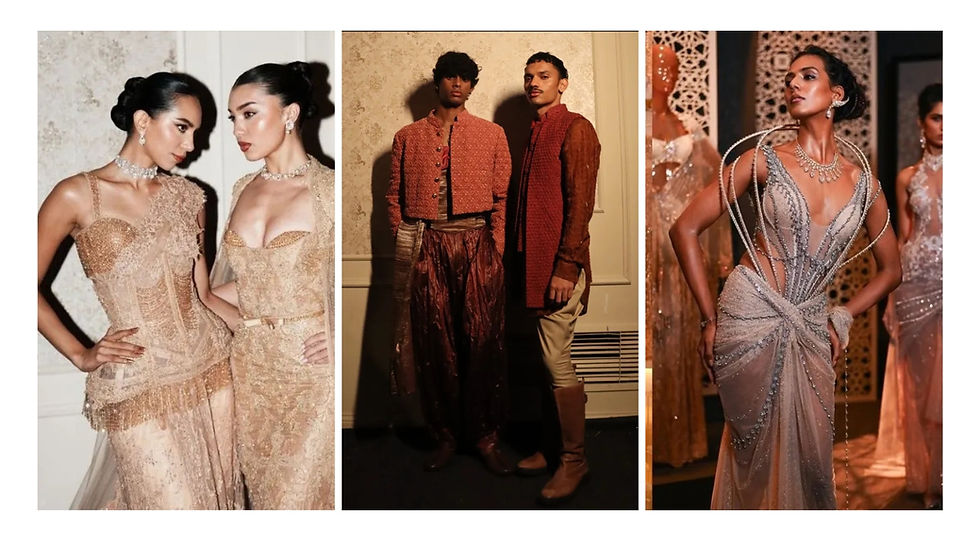
In the past, Indian wedding couture didn't leave much room for reinvention, but over the years we've witnessed a refreshing shift. Yes, the lehenga, the saree and the colour red continue to hold their place, but every season's real evolution happens at the edges: a new silhouette here, a reworked textile there. While the foundation remains largely true to the traditions handed down through generations, designers are finding increasingly inventive ways to reinterpret it.
Hyundai India Couture Week 2026 pushed harder against those boundaries than usual. Across six days, designers didn't abandon tradition so much as challenge it: structure versus ease, weight versus movement, and menswear becoming noticeably more experimental. Falguni Shane Peacock introduced feather-trimmed jeans, House of Masaba sent a Pathani down the runway, Arpita Mehta's oversized mirror embellishments became an ode to glamour, while Rohit Bal's Victorian-inspired statement collars brought back romance. Perhaps the biggest takeaway was that almost every collection extended beyond bridalwear, offering versatile pieces that could be worn across multiple occasions, and that felt like one of couture's biggest wins this season.

This season finally felt like Indian couture was responding to the growing demand for its next reinvention. From sculptural corsetry to lightweight lehengas, the 2026 wedding fashion trends unveiled at Hyundai India Couture Week proved that Indianwear is entering a bold new chapter.
Corsetry
Corsets may have originated in the Victorian era, but they've steadily found their place within Indian couture. While they weren't always as widespread, Tarun Tahiliani has consistently championed the silhouette. This season, corsetry was reimagined, no longer hidden beneath a garment but becoming the garment's defining structure. At Navaratna, Tahiliani presented a part-corset, part-bodysuit that made a compelling case on its own. Many compared it to Schiaparelli, and understandably so, but seeing such exceptional construction executed within Indian couture elevated the conversation entirely.
Tarun Tahiliani
Isha Jajodia took the idea further. Her label, ROSEROOM, built an entire vocabulary around lace and corsetry, where corseted gowns and skirts shared runway space with sharply tailored jackets and tuxedos. Here, the corset stopped feeling like a bridal cliché and instead became an exercise in tailoring. Lace featured prominently throughout the collection, while corseted gowns, structured blouses and intricate bead tassels held everything together.

Isha Jajodia
Arpita Mehta, making her couture debut with Ceremonial, joined the conversation in her own way. Corseted blouses appeared alongside capes and sculptural skirts, pieces designed to stand on their own rather than simply complement a lehenga. Mirror work and shimmering embellishments gave the corsets a distinctly Indian identity, seamlessly integrating the trend into occasion wear.
Image credit: L-R Arpita Mehta, Rohit Bal, Jayanti Reddy, Aisha Rao
Rohit Bal also introduced subtle glimpses of corsetry, although they never became the collection's focal point. Aisha Rao experimented with corsets in playful colours and bold prints, while Jayanti Reddy interpreted the silhouette through dramatic peplum constructions, shifting the focus towards shape rather than embellishment. The overall effect was a wardrobe quietly reorganising itself. Blouses and skirts no longer behaved like matching sets. Instead, they became separates, each confident enough to take centre stage.
Weightless, Not Weak
Tarun Tahiliani has long maintained that he doesn't want his bride to be "weighed down by the sheer weight of couture", and this season proved exactly that. An equally strong pursuit of lightness matched the movement towards structure. A season chasing structure was also, paradoxically, a season chasing lightness. The pointed retreat from the 44-pound embroidered lehenga, Tahiliani among those leading it, wasn't restraint for its own sake. It was a practical demand: a bride who wants to actually dance at her own wedding, not manage her outfit through it.
Second in line was Masaba Gupta, whose debut featured everything from pineapple bags and bikinis defining resortwear to lightweight embellished lehengas and Pathanis, floor-length anarkalis, heavily embellished lehengas teamed with knotted tops, barely-there blouses, and a thoughtful balance where one piece remained embellished while the other stayed understated.
Image credit: L-R House of Masaba, JJ Valaya, Anamika Khanna, Arpita Mehta
Joining the conversation around lightness was JJ Valaya. This time, we got to touch and feel the lehengas we often see only on the runway. Upon lifting each one, despite its heavily embellished appearance, the weight didn't match the look—each lehenga was remarkably lighter than expected. The presence of silhouettes such as embellished jackets and tasselled capes paired with solid sarees further reinforced the idea.
Anamika Khanna echoed the same sentiment through draped silhouettes paired with statement embellishment, each piece strong enough to exist independently. Mehta's Ceremonial made the same case differently, pairing rich embroidery with fluid saree gowns and sculptural tailoring built for movement rather than display. Ease, not excess, is becoming the measure of couture-level bridalwear. Fluidity and ease of movement were recurring themes throughout Kunal Rawal's collection as well.
Dupatta-less Lehengas
Image credit: L-R Rohit Bal, House of Masaba and Aisha Rao
Dupattas are, in many cases, the first thing we wish to throw off after a wedding function. Rohit Bal, Aisha Rao and House of Masaba championed lehengas without dupattas. While the trend has existed for several years, it felt far more prominent this season. The absence of the dupatta allowed the lehenga and blouse to champion craftsmanship, detailing and construction without distraction.
Mother-Of-Pearl Detailing
A material more commonly associated with interiors found an unexpected place on the couture runway.
We saw it extensively in Rimzim Dadu's creations, offering an entirely new perspective on embroidery—an unconventional one at that. She interpreted the craft of inlay and transformed it into couture. Hundreds of individually cut pieces of mother-of-pearl were embedded within her signature metallic textile grids, creating sculptural surfaces that transformed with light and movement.
Image credit: L-R Tarun Tahiliani and Rimzim Dadu
Another interpretation appeared in Tarun Tahiliani's couture collection, Navaratna, as part of the Traditional Room. This time, Jaipur-based artisans embellished the back of a blouse using naturally occurring mother-of-pearl, arranged in a tastefully orchestrated pattern that doubled as embroidery.
Puff and Leg of Mutton Sleeves
Image credit: L-R Rohit Bal, JJ Valaya and Roseroom
Bare shoulders may still exist, but voluminous sleeves firmly dominated this season. Rohit Bal and JJ Valaya proved that voluminous sleeves aren't going anywhere. While velvet and organza remained the preferred fabrics, feathers added drama in collections by Falguni Shane Peacock and ROSEROOM.
Skin as Statement
This season, skin continued to be revealed, but with intention. Backless blouses and plunging necklines continued to trend, reflecting what designers describe as a more body-confident bridal client, one less inclined to disappear beneath layers of fabric. One particularly interesting sighting was Dolly J's cropped corsets paired with lehengas, a combination we hadn't quite seen before.
Image credit: L-R Falguni Shane Peacock, Anamika Khanna, Dolly J and Rahul Mishra
Short dresses, high slits and sheer fabrics also continued to feature prominently. Dolly J, Rimzim Dadu and Rahul Mishra all presented some of the strongest interpretations of the trend.
A Trousseau Beyond Red
Whereas colour told a subtler version of the same story. Red held its ground for the phera, as it always does, but the trousseau around it has loosened. Periwinkle, blush and lavender worked their way in, sitting alongside deep wine and midnight black for the events beyond the wedding day itself. Mehta's palette at Ceremonial traced a near-identical arc, moving from coconut, rose tan, sage, seafoam and teal into violet and sindoor red. The collection's standout look, a deep purple Bandhani lehenga paired with an off-shoulder bustier and a mirror-embellished, shell-fringed dupatta, felt like a distillation of the whole week's colour logic in a single outfit.
Image credit: L-R House of Masaba, Rohit Bal, JJ Valaya and Aisha Rao
House of Masaba took that same loosening somewhere entirely its own. Masaba Gupta's Chardi Kala marked her first proper bridal couture showcase, and it read like a rebellion dressed as a wedding line: supersized prints, pineapples and tropical motifs rendered in metallic shine, a palette running from pastels into full jewel tones, all built around a narrative that carried the bride from India's sacred landscapes into the waters of the Caribbean. It was less about reworking the lehenga's shape than about refusing to let colour and print sit quietly within it, which fit the week's broader mood more than it first appears to.
Craft, Unmoved
Underneath the shifting silhouettes, craft stayed constant. Bandhani, Banarasi, tissue, Kantha, zardozi and kashidakari ran through collection after collection, proof of an industry leaning harder into artisan-led work even as its shapes modernise around it. Mehta's debut leaned on the same textiles and introduced Kantha to her own vocabulary for the first time, hand-stitched into classic cream gowns in a way that let the embroidery carry the story rather than the cut.
L: Anamika Khanna; R: Arpita Mehta
Anamika Khanna, too, placed craft at the heart of Moonlit Palace, celebrating the textile traditions of Barmer through mirrorwork, hand-painting, gold foil and intricate embroidery developed in collaboration with women's artisan communities. Rather than preserving these techniques as they are, she reimagined them for contemporary couture, reinforcing that craftsmanship remains Indian couture's greatest strength.
The Groom Gets a Say
It wasn't only the bride who was being reconsidered. The groom's wardrobe stretched further this season than it has in years. Fluidity and ease of movement remained recurring themes throughout Kunal Rawal's collection. His 150-look Rawalgarh, celebrating fifteen years of the label, gave grooms a much larger share of the couture conversation. Modular tailoring and engineered hardware, including the Magnetic Stole, allowed grooms to effortlessly rework their silhouettes mid-ceremony without the usual choreography of readjustment.
Rahul Mishra also introduced lighter menswear silhouettes, pairing solid kurtas with embellished jackets and subtly embroidered kurtas featuring detailing only along the borders.
Image L-R: Falguni and Shane Peacock, Rohit Bal, Kunal Rawla and Rahul Mishra
Rohit Bal, returning to the runway, made the opposite argument just as powerfully. Where Rawal embraced functionality, Bal leaned into the label's enduring strengths: sherwanis crafted in structured velvet and silk, richly adorned with zardozi, floral embroidery and pearl detailing, cut with just enough contemporary tailoring to keep them from feeling costume-like. Between the two, Indian menswear this season stretched from futuristic ceremonial dressing to unapologetic opulence, a clear sign that the groom has finally stopped being an afterthought at bridal couture shows.
Taken together, the week reads less like a break from tradition than a renegotiation of its terms. The embroidery, the colour codes and the extraordinary craftsmanship remain exactly where they've always been. What's changed is the weight the bride is expected to carry, literally and otherwise.


Comments