
6 Indian Designers Who Have Launched Jewellery Collections
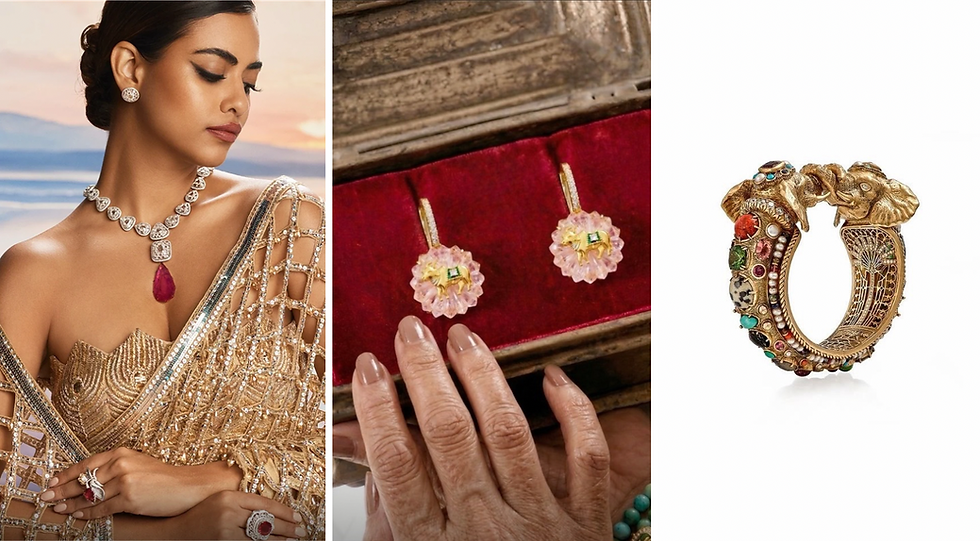
For years, jewellery in India belonged largely to an established circle of family jewellers. But that is beginning to change. Some of the country’s most recognisable fashion designers are stepping into the category, bringing with them the visual languages they have spent years building. And perhaps that is what makes this moment so interesting: jewellery is no longer simply an accessory to the designer’s clothes. It is becoming another way to enter their world.
From Sabyasachi’s jewellery universe and Manish Malhotra’s expanding fine and high jewellery lines to Abu Jani Sandeep Khosla’s debut Iconic Jewels, Tarun Tahiliani’s collaboration with Nebula by Titan and Masaba Gupta’s fine jewellery with Amrapali, designers are translating the codes of couture into pieces designed to live beyond the runway. We take a closer look at the Indian designers who have ventured into jewellery, and are making a serious case for fashion’s newest heirlooms.
Manish Malhotra
Manish Malhotra’s jewellery journey began in 2019, with the designer formally launching Manish Malhotra High Jewellery in 2023. And if there was ever a designer for whom “more” felt like the obvious starting point, it is Malhotra. His high jewellery brings together diamonds, polki, emeralds, rubies and South Sea pearls in sculptural pieces that carry the same sense of drama as his couture. His signature Armour House Cut adds yet another layer of recognisability.
The pieces are designed for an entrance. Take Jennifer Lopez’s ILENA necklace, featuring 165 carats of emeralds alongside an array of trillion-cut diamonds. It does not simply finish a look; it becomes the look.
But there is a daintier side to Malhotra’s jewellery story now. In 2026, Malhotra expanded the conversation with The M Collection, a more everyday fine jewellery line built around his signature M. Spanning rings, earrings, bracelets and lariats, the collection combines 18-karat gold with natural and black diamonds, ceramic, malachite, black onyx and mother of pearl. Designed to be layered, stacked, reversed and transformed, it is fine jewellery that feels personal rather than precious. His High Jewellery is made for the grand entrance; the M is for everything that happens afterward.
Sabyasachi
Jewellery has never really been new territory for Sabyasachi. Sabyasachi’s relationship with jewellery goes back long before his fashion empire. In the early days of his career, he sold costume jewellery to street vendors in Calcutta to help fund his first fashion collection. His maiden collection, formally launched in 2017, in some ways, feels like a full-circle moment.
Today, that early fascination has grown into a jewellery world of its own. His pieces draw from old Calcutta, Bengal filigree and reinterpreted jadau, with references to Mughal and temple jewellery woven through 18-karat gold, uncut diamonds, pearls, emeralds, rubies and coloured gemstones. The Royal Bengal tiger has become one of his recognisable motifs, while Art Deco occasionally finds itself alongside more traditional Indian forms. Sabyasachi has also made it his mission to bring the work of Calcutta’s master goldsmiths, the babus, back into focus, at a time when many of these heritage techniques are becoming increasingly rare. His belief is that as these crafts disappear, their legacy could eventually be worth more than the gemstone itself.
From Indian brides to Rihanna and the Oscars, his jewellery has travelled considerably further than Calcutta. Now, his collaboration with The Metropolitan Museum of Art, set to debut in September 2026, brings another chapter, with its first High Jewellery collection drawing on Byzantine art and objects from the museum’s Greek and Roman, Medieval and Islamic collections, reinterpreted through Indian craftsmanship.
Abu Jani Sandeep Khosla
Forty years into their design journey, Abu Jani and Sandeep Khosla have entered jewellery with Iconic Jewels, their first jewellery collection. Launched in September 2026, the collection brings the duo’s famously maximalist couture language into 18-karat gold, diamonds, pearls, Zambian emeralds, Mozambique rubies and multicoloured sapphires. Fronting the campaign is their original muse Dimple Kapadia, who first modelled their Chikankari collection in 1993.
Housed at The Vault at Mubarak Baug, their Mumbai flagship, the collection feels like a natural extension of their fashion vocabulary. Embroidery becomes ornament, colour becomes gemstones and the designers’ love of elaborate detail gets translated into jewels. Individual chapters draw on different elements of their couture archive: Abad references Patola embroidery, Roshnai brings together Chikankari and Mughal ornamentation, while Rudra and Taweez explore spirituality and symbolism.
Then there is Junoon, an emerald and ruby dragon cuff that winds around the forearm. It is theatrical, sculptural and unapologetically extravagant. It is dramatic in exactly the way you’d expect.
Tarun Tahiliani X Nebula By Titan
Timeless drapes and Tarun Tahiliani are synonymous. Launched on August 5 2026, his Phool Chadar, created with Nebula by Titan, takes a slightly different route into this world. Instead of translating couture directly into jewellery, the designer has brought his visual language into fine watchmaking.
Inspired by the traditional floral canopy carried over the bride as she enters her wedding, the collection brings together sculptural florals, jaali patterns, Polki-inspired details, Chandak work and antique-finished 18-karat gold. There are four creations — Gulistan, Kyaari, Kalli and Mandala — alongside the TT Signature Men’s Edition. Each approaches the idea differently, from Gulistan’s sculptural floral bracelet and Polki detailing to Kyaari’s kada-inspired silhouette. The men’s edition brings Tahiliani’s signature jaali into the dial, paired with an in-house hand-wound mechanical movement.
What makes the collaboration work is that the watches still feel like Tahiliani. The references are unmistakably Indian, but the finished pieces are contemporary enough to live beyond the wedding day.
Phool Chadar may mark the moment; this one is made to stay.
Papa Don’t Preach
Papa Don’t Preach entered high jewellery in 2026 with The Observatory. Shubhika Sharma's inspiration behind her fine jewellery line started with her mother. As a child, she watched her collect one piece every year, sometimes a tiny necklace, a delicate pair of pearls or a simple chain. Nothing particularly extravagant, but always chosen with care. Those visits to jewellery stores were where she developed her eye for beauty, and an appreciation for pieces that could last.
That idea has now found its way into Papa Don’t Preach. Known for its colourful, maximalist world, the brand has brought that same sense of storytelling into jewellery, creating pieces meant to become part of milestones and, eventually, memories.
The collection, takes a less conventional approach to the category, with oversized chokers, handcuffs, rings and earrings in 14- and 18-karat gold, uncut diamonds and coloured gemstones. The 40-piece collection is designed as heirloom-worthy jewellery, with each piece accompanied by a hand-drawn sketch, signed and dedicated by Sharma.
There is something quite lovely about that contrast: jewellery that looks anything but quiet, but comes from a very personal idea of what makes a jewel worth keeping. And that feels like the right note for Papa Don’t Preach. The pieces are dramatic and playful, but underneath all that colour is the same idea Sharma grew up with: buy something because you love it, and let it gather meaning as you live with it.
Masaba Gupta X Amrapali
Masaba Gupta’s move into fine jewellery feels particularly personal because, in a way, the jewellery was already there. The symbols that have become part of the House of Masaba world — the palm, Nandi, the toffee and the camera, have been appearing on her prints for years. Now, they have become pieces you can actually wear.
Her collaboration with Amrapali in January 2025 turned those motifs into charms, earrings, chokers and haslis, almost like little talismans. Set in 18-carat gold with coloured gemstones including yellow sapphire, peridot, rubies, morganite and aquamarine, the pieces are colourful, playful and very Masaba.
There’s a chunky camera earring, a kada inscribed with words such as peace and strength, and a necklace bearing Nirbhau, Nirvair, Nimrata. The Trinket Hoarder necklace perhaps sums it up best. With its mix of coloured stones and different motifs, it feels collected rather than perfectly matched; which is also how Masaba likes to wear jewellery herself.
That is what makes it feel like Masaba jewellery, rather than simply jewellery designed by Masaba. She has taken the things that already belong to her world and made them something you can keep.
For a long time, the really special pieces were saved for weddings, anniversaries and the occasional very important dinner. That is changing. Jewellery is increasingly being worn as part of everyday style, and Indian designers jewellery is helping push that shift forward.
A Sabyasachi necklace can move from a wedding to a red carpet. A Masaba charm can work just as well with a white shirt. A Manish Malhotra M can be layered every day, while a Tarun Tahiliani timepiece can sit alongside a wedding wardrobe without being reserved for the big day.
Perhaps that is what makes these new designer jewels feel like heirlooms in the first place. You buy them now, wear them often, attach your own stories to them and, eventually, someone you love gets to do the same.


Comments