
The Audemars Piguet x Swatch’s “Royal Pop” Collection Frenzy Reveals That Luxury Was Never Meant To Be Democratic


When Audemars Piguet and Swatch announced a collaboration, the internet buzzed with anticipation of an affordable Royal Oak wristwatch. AI-generated mockups of vibrant, modern Royal Oaks circulated widely, capturing the hope that luxury could finally become accessible to all.
On May 16, 2026, what arrived instead was something smarter — The “Royal Pop” collection. The brands delivered a clever twist with a playful reinvention of the Royal Oak as a limited-edition Bioceramic pocket watch inspired by Swatch’s 1986 POP Swatch concept. But it wasn't a Royal Oak wristwatch; it was a pocket watch. Priced between $400 and $420, this was a dramatic leap from the Royal Oak’s traditional $4,500 entry point.
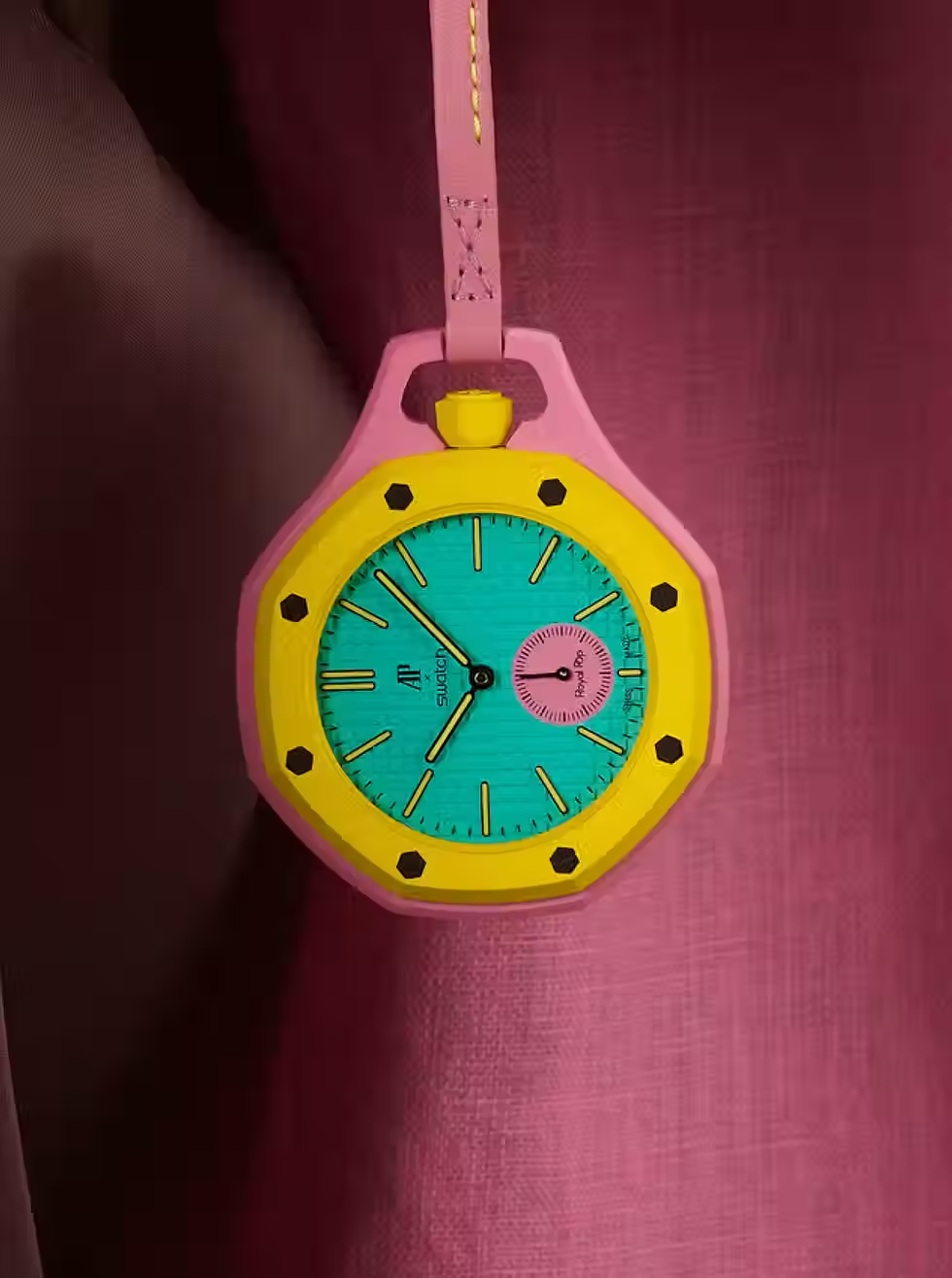
The “Royal Pop” release sparked global excitement— stores were crowded, secondhand markets grew, and in some regions, the police were called in to control the crowds. This frenzy surrounding Audemars Piguet and Swatch’s “Royal Pop” collaboration says far more about modern luxury consumption than it does about watchmaking itself. Because beneath the queues, resale hysteria, and social media spectacle lies a deeper question luxury brands are increasingly reluctant to confront openly: What happens to luxury when everyone can access it?
For decades, true luxury operated on distance. It was aspirational precisely because it remained inaccessible to most people. The Royal Oak was one such creation, and it remains one of the most culturally recognisable watch designs ever created. Designed by Gérald Genta in 1972, the octagonal bezel, exposed screws, and integrated bracelet have evolved far beyond watchmaking, becoming symbols of wealth, taste, and insider status. Pocket watches from the Audemars Piguet x Swatch “Royal Pop” Collection are strikingly similar in design to the Royal Oak code, priced at $400 to $420, sold only through 200 selected Swatch stores worldwide, and limited to one per person. Given such marketing, it was sure to draw the crowd. And while affordability remained a key factor in garnering crowds and chaos, the real product being sold was proximity and accessibility — consumers want what feels temporarily unreachable, and scarcity has become coveted.

Collaborations like this offer consumers proximity to elite design codes without granting entry into the actual world those codes belong to. And perhaps that is precisely why they work so well. The Royal Oak, introduced in 1972, was a status symbol, and even today, the brand retains that status. When it was made "accessible" through a collaboration with mass-brand Swatch, people were not in line for a pocket watch alone; they queued for scarcity, social proof, resale value, and content as much as for the object itself. Swatch, on the other hand, has mastered something equally valuable: accessibility wrapped in collectability. The brand has spent decades understanding how colour, nostalgia, limited drops, and playful design can create emotional urgency. Together, the two brands created a product positioned perfectly between aspiration and attainability.
The gap between expectation and reality gave people something to debate online. Some mocked the pocket watch format. Others loved the absurdity of it. Many bought it simply because everyone else was talking about it, while others decided to make a quick buck. What this shows about luxury is that consumers are not buying luxury to quietly own something beautiful. They are buying evidence of access and social status. People don’t just want luxury products anymore. They want proximity to elite worlds that they normally cannot enter.
In the end, the value of the Royal Oak was never just craftsmanship; it was scarcity, rarity, and restriction — the understanding that not everyone could have one. The “Royal Pop” collection was not truly about democratizing Audemars Piguet. If anything, it reinforced the hierarchy.
However, it is worth noting that once luxury becomes entirely accessible, it ceases to function as luxury and becomes premium mass consumption. Scarcity is not an unfortunate side effect of luxury; it is the very mechanism that gives it meaning. The waitlists, the allocation politics, the invitation-only launches, the discreet client relationships, the quiet understanding that not everyone will get one — these are not flaws in the system. They are the system. The collaboration succeeded because it offered consumers the illusion of entry while carefully protecting the actual gates.


Comments