
The Runway Rundown: All the Highlights From Paris Couture Week 2026

Updated: Jul 15
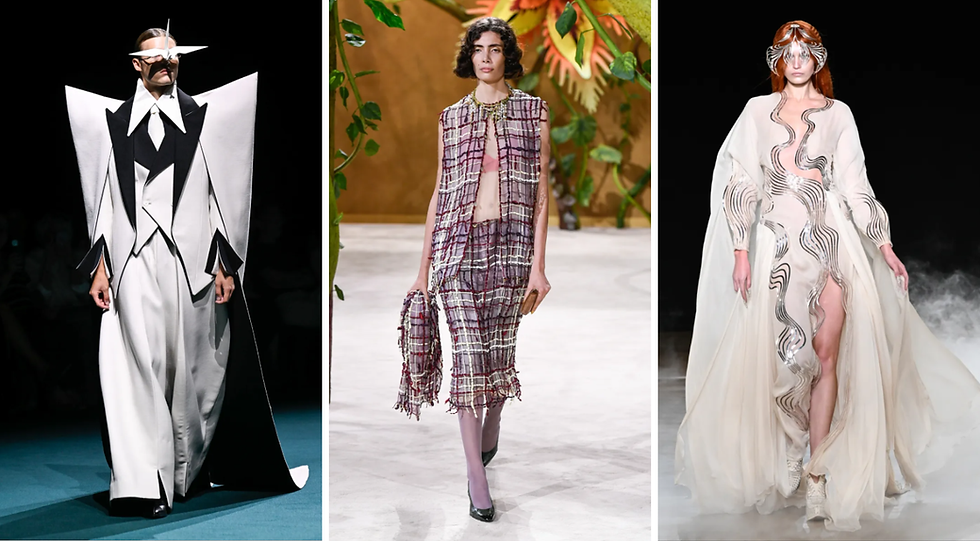
Paris Haute Couture Week 2026 delivered exactly what the calendar promises twice a year: fantasy, precision and the kind of craftsmanship which exists nowhere else in fashion. From the ateliers of the old guard to a landmark debut that made history for Indian design, this season's shows proved that couture is still the industry's most potent form of storytelling. Corsetry got a rethink, embroidery reached new extremes, and silhouettes moved between the theatrical and the deeply personal. Here's The Style List Runway Rundown. We’re breaking down the must-know looks and biggest highlights from the Fall/Winter 2026–2027 Haute Couture Week in Paris.
Rahul Mishra
Rahul Mishra brought ancient India roaring into the present at Paris Haute Couture Week with Devi: The Eternal Muse, his Autumn/Winter 2026/27 collection. Drawing on the carved sculptures of South Indian temples, Mishra built an homage to the eternal feminine, calling the process "almost like time travel" as he brought centuries-old stone figures to life on the runway.
The craftsmanship was staggering — zardozi, dabka, crystals and bugle beads layered into featherlight couture that somehow read as sculptural. Skin-toned bodysuits dissolved the line between body and garment, while dense embroidery mimicked the texture of carved stone. Temple crowns and jewelled headpieces, built straight into the garments, turned models into living statues in a palette of stone grey, ivory, antique gold and black.
The collaborations elevated the narrative further; clay artisan Sumant Kumar created headpieces inspired by temple crowns, milliner Stephen Jones s designed veils and Tanishq Natural Diamonds all lending their craft. As everyone on the internet is saying, God really is a woman.
Manish Malhotra
Manish Malhotra just rewrote the rules of Indian couture. At Paris Haute Couture Week 2026, the designer unveiled 'Maa', his debut haute couture collection. 'Maa' is less a collection than a love letter. Built around the universal pull of a mother's embrace, it folds decades of Malhotra's own history into its seams, all filtered through his signature extravagance and the meticulous hand-worked artistry India is known for. On Instagram, he traced the collection back to its source: "The colours of my childhood in the 70s were the colours of my mother's saris." That sentiment ran through every look, nostalgic, tender, and unmistakably rooted in Indian craft, even as it spoke fluent French couture.
From sculptural 3D silhouettes and dramatic drapes to exquisite vintage salli, zardozi and hand embroidery, every look was a celebration of Indian craftsmanship at its finest. Soft blush and rose hues, inspired by his mother, were paired with regal jewellery-inspired embellishments, while Manish Malhotra High Jewellery completed the story with precious gemstones honouring motherhood in its most timeless form.
Staged at the historic Pavillon Cambon Capucines, the show marked Malhotra's first-ever appearance at Paris Haute Couture Week, and the collection unfolded across four chapters: Cocoon, Bond, Becoming and Abundance. It's a structure that traces an entire emotional arc, moving from sculptural, protective silhouettes that mirror the shelter of early life, through fluid draped forms that speak to connection, towards monumental, richly embellished gowns that mark the passage into identity and, finally, legacy. The craft shifts in step with the story, with intricate vintage salli, zardozi and hand embroidery anchoring the earlier chapters, giving way to grander, more opulent embellishment as the narrative builds towards Abundance.
The story continued into Manish Malhotra High Jewellery, where diamonds, rubies, kunzites, rubellites and sapphires became sculptural tributes to motherhood in its most timeless form. By his own account, 'Maa' is Malhotra's most personal couture statement yet: intimate, instinctive, and deeply his own.
Iris Van Herpen
Iris van Herpen has quietly done what no couturier has before: woven plasma, the mysterious matter behind the aurora borealis and lightning, into wearable form. Her Fall 2026 collection, "Sonic Starquakes," takes its cue from the fact that stars are never silent, translating the low hums and high celestial notes of stellar pressure waves into cloth.
Tens of thousands of hand-blown glass spheres, graduating from seed pearl to soap bubble, float across illusion tulle until the body seems to dissolve into a fizz of light. Elsewhere, waning-crescent glass tubes filled with actual plasma swoop from the shoulder, crackling and glowing as they respond to the wearer's own magnetic field. A strapless lightning minidress in annealed PMMA required a particle accelerator and a cryogenic crate chilled to minus 100 Celsius to produce its Lichtenberg branching, fern-like patterns etched straight into the material. The plasma and lightning dresses rank as museum pieces,
Hand-pleated chiffons swing into half-wheels on moon-curved carbon fiber boning, while laser-cut velvets ripple into hand-embroidered rivulets across bare skin. The palette moves through midnight black, sapphire, moonstone green and storm-lit silver, unspooling over a floor thick with dry ice.
Schiaparelli
Daniel Roseberry opened Paris Couture Week determined to prove that no algorithm can outdo the human hand, sending out a Schiaparelli collection that read like a plunge into the uncanny. Latex jackets and bustiers were moulded into jelly-like silicone, and gowns pulsed with embedded light, all while gelatinous textures and flesh-toned silicone gills pushed the body into unfamiliar territory.
A committed sketch purist, Roseberry has grown wary of AI's creep into design education, yet he's never shied from provocation. Here, he leaned into the tension between haute couture's centuries-old handwork and distinctly unnatural materials, pairing traditional techniques with latex, silicone, dried flowers, seashells and fish scales. Glossy, pneumatic jackets and corsets echoed the stiff drama of Kim Kardashian's Allen Jones breastplate at the Met Gala, while rubbery dresses clung and quivered with an unsettling undertone, even in softer pieces like Amelia Grey's putty-pink, pearl-embroidered prom dress.
The inspirations were deliberately eerie, drawn from the disquieting visuals of Matthew Barney's "Cremaster Cycle" and developed with a Parisian workshop known for crafting photorealistic silicone babies for film, all tracing back, Roseberry insists, to Schiaparelli's own surrealist roots.
Stéphane Rolland
Stéphane Rolland's Fall/Winter 2026-2027 haute couture collection unfolded like a recital, each silhouette a chapter in a story built on light, restraint and quiet emotion. The collection drew its title, "Olympia," from a spirit that hovered throughout, present in the verticality of every silhouette reaching toward light and in the almost magnetic pull of certain gowns.
Rolland found his inspiration in the great French lyricists, particularly Jacques Brel and Léo Ferré, whose songs explored love, longing and solitude with unflinching sincerity rather than easy sentiment, and he took over the legendary venue where the singer wrote his final songs. That same truthfulness shaped the show's structure. Opening looks appeared in near-absolute light before the collection gradually deepened, embroideries multiplying and volumes swelling as deep reds, intense blacks and flashes of silver entered the narrative, building emotional intensity while never losing its composure.
Vaishali S
Vaishali S returned to Paris Haute Couture Week with "Swayam," a collection built entirely around the idea of self-possession, its name drawn from the Hindi word for "of one's own accord." Staged at the Indian Ambassador’s residence, the show unfolded like a breath across three movements: Beej, the sealed seed; a threshold; and Mukti, full bloom, with the palette shifting accordingly from stone and ash into carmine, amethyst, peacock and sapphire.
At its core sat Vaishali Shadangule's signature cording technique, a proprietary method that transforms flat handloom into sculptural, botanical form, turning bodices into blooms and freezing pleats mid-motion in ways no machine can replicate. Fourteen Indian handloom traditions, including Banarasi, Kanjivaram, Jamdani and Patola, ran through every piece, the work of over 4,500 weaving families across seven Indian states and 25 years of trust between designer and artisan.
Models walked barefoot, a deliberate nod to staying rooted even while blooming, set to the resonance of live Indian classical music. As Shadangule put it, "You do not need to be admired to be allowed to open. You only need to be true."
Standing Ground
Standing Ground Couture displayed its Irish Roots with its debut collection in Paris Haute Couture Week this year. Founded by Michael Stewart in 2022, the brand brings elegant maxidresses with sculptural features and cloak-like frocks, straight out of the Dune book. With twisted drapes and pleats, supported by clunky beads and an inclination towards sci-fi inspiration, the collection didn’t come across as a reinvention but as an extension of the techniques the designer has been honing since 2017. Michael’s signature covered beading and tailored looks took the spotlight alongside the sheer bridal gown made of Carrickmacross lace, worn by Kristen McMenamy, crafted over 4,000 hours.
Part intergalactic and part an ode to the meticulous craft of working with textural and sculptural elements, the collection took over the salons of the Irish Embassy in Paris. With an opening look featuring a bias-cut silk skirt and a structured jacket with covered beads sealed under a sheer jacket, the young couturier established the tone of the show as an alternative dystopian future reimagined in structured silhouettes and lace.
Dior
Having secured the bridal commission of the year, Jonathan Anderson is back with a pleated collection for Couture Week. Featuring shimmering gowns, dresses made entirely out of embroidered flowers and a black reflective runway with ferns on display.
The Dior show didn’t shy away from continuing themes of garden and nature seen in previous collections. Not limited to garments, the collection featured four handbags created in collaboration with American sculptor Lynda Benglis. Having previously featured Benglis’s sculptures in 2013 while at Loewe, Anderson has displayed the artist’s work in nuances comprising chiffon blouses, trousers and jackets for Dior this couture season. The garments had large wire mesh fans decorated with a constellation of brightly-coloured and metallic ornaments, inspired by the birds she saw whilst staying at the Sarabhai family estate in Ahmedabad.
Reimagining the mirrored halls of the Musée Rodin for a runway, the collection displayed sculptural harmony in wrap coats and body-skimming gowns in satin silk, alongside an iteration of the signature Bar jacket with green fringe, ruffles and sheer layers. Deeply inspired by Benglis and their shared fascination with structures and form, the collection zeroed in on pleats with an asymmetric crop top worn with sharp trousers. After which pleats became a recurring element with accessories and silhouettes alike.
Chanel
Whimsy never seems to leave Chanel, and definitely not when Matthieu Blazy is curating the collection. The Haute Couture show opened with a sheer mousseline skirt suit, and the model carried a leather-bound copy of Les Fées, Contes des Contes that belonged to the founding couturier of the house, Coco Chanel. Followed by clothes featuring twisted vines and pastel grid lines, a row of buttons that moves from an ugly duckling to a swan, and the heel of a shoe with a golden egg, the show conjured the world of fairytales.
With an invite that hinted at the beanstalk-verse from Jack’s adventure, it materialised in reality with the set and the lore woven into the garments. The deeply immersive and embellished looks from the collection were balanced by a series of liquified gowns, delicate organza and guipure lace with Romaneque drapes drawing inspiration from Gabrielle Chanel’s work. “If you think couture is a big painting, at Chanel it’s maybe a miniature,” says Blazy backstage.
Eli Saab
Stepping out of a noir movie, Eli Saab’s 2026 collection at Palais de Chaillot featured lace masks and sculpted headpieces with wings, spiral drapes, and structured forms. Dresses in organza, embellished with pearls and reminiscent of a Dark rose with red, black and rose-gold hues on one end and the palette of metallic blue, fuchsia, and pastels on the other, the collection at large spoke of opulence and mystery with models dressed as calla lilies and midnight swans.
Continuing his trail of designing flowing goddess dresses in soft pastels, Elie Saab introduced velvet ballgowns, winged columns and sharply cut tuxedos with his latest collection.
Robert Wun
Robert Wun drew inspiration from Hayao Miyazaki’s philosophy of imagining a constructive utopian future for future generations. He revisits his childhood archetypes, offering an ode to Disney heroines and autobiographical references to create a collection rooted in surrealist silhouettes. Opening with a splash of paint on a dress and continuing into solid shapes with colour blocking, the collection featured exaggerated proportions, prominent pinstripes, and sparkling embroidery.
With a Snow White-inspired pleated gown and a depiction of Bambi’s mother with a white horned headpiece carrying a doll representing Bambi, giant toys were seen throughout the show. It is with the final tailored looks towards the end of the show that Wun’s experimental flair with this collection is seen. Having the crinoline of a black dress studded with balloons and exaggerated shoulders for structure, the collection embodies childlike wonder by imitating Tchaikovsky's protagonists, whom the designer grew up with.
Ashi Studio
Emphasising his signature style of dramatic architecture, Mohammed Ashi's recent collection revolved around the spectrum of three hues: white, black and muted metallics. Featuring sharp shoulders, voluminous exaggeration, and corseted waists, the collection drew inspiration from European history.
With leather transformed to resemble a ceramic surface, hand-painted insects, crustaceans concealed under the linings and a mirror embedded in the back of a gown, the collection leaned heavily on craftsmanship in the silhouettes. Staging the historical role-play in the spirit of a Salvador Dali party, the fabric and material manipulation traded physical qualities to alter perception of reality. Celebrating the label’s 20th anniversary, the Saudi label depicts a scene of metamorphosis and transformation at Couture Week this year. The designer utilised feathers, raffia, moire taffeta, and shredded chiffon, with vintage corseting and boning techniques to conjure silhouettes appearing like armour on the body. The collection, at large, was a gothic fever dream that transported the viewers from a runway to various historical timelines.


Comments