
India at Met Gala 2026: Best Dressed Celebrities Who Owned the Red Carpet


Fashion is art—and India at Met Gala 2026 proved just that. This year, India didn’t just show up, it owned the moment. From Ananya Birla’s striking debut in Robert Wun paired with Subodh Gupta, to Karan Johar bringing couture drama in Manish Malhotra, the red carpet turned into a strong showcase of Indian fashion. Isha Ambani stood out in a Gaurav Gupta saree with an encrusted statement bag, while Gauravi Kumari and Sawai Padmanabh Singh made a royal debut in Prabal Gurung. Across the red carpet, Manish Malhotra’s couture and jewellery made a strong impact, showing how well India at Met Gala 2026 understood the theme.
For many of these stars, more was more—but Indian heritage and craft stayed at the centre. Karan Johar’s look was inspired by Raja Ravi Varma, bringing art into fashion. As he shared, “Raja Ravi Varma felt right because his work does something I’ve always tried to do in cinema. He painted feelings.” At the same time, Diya Mehta Jatia stood out in a Kanjeevaram and Bengal shola craft gown by Mayyur Girotra, mixing traditional textiles with a modern look.
This was India at Met Gala 2026 on the global stage—scroll through for the best-dressed Indians of the night.
Isha Ambani in Gaurav Gupta
Isha Ambani Gaurav Gupta Met Gala India at Met Gala: Isha Ambani couture saree Met Gala 2026 look
At the Met Gala 2026, Isha Ambani delivered a standout moment for India at Met Gala. She opted for a custom Gaurav Gupta couture featuring a jewellery-integrated blouse set with over 1,800 carats of heirloom diamonds and gemstones, paired with a gold-woven tissue saree, blending centuries of Indian craftsmanship into a contemporary couture masterpiece. Styled by Anaita Shroff Adajania, the ensemble drew from India’s textile and visual history—from the Indus Valley to classical Indian art.
The key highlight of the outfit was a blouse covered in over 1,800 carats of diamonds and precious stones, including heirloom pieces like old mine diamonds, emeralds, polki, and kundan from Nita Ambani’s collection. Crafted by 40 artisans across India, the blouse featured handwork like zardozi, dabka, and nakshi embroidery, taking over 500 hours to complete. There was even a historic Mughal-era sarpech at the back, adding another layer of heritage and history to the look. She paired this with a gold-woven tissue saree, keeping the drape traditional, making it look grand and wearable at the same time.
But then the drama kicks in with that oversized sculptural headgear, which instantly makes it feel Met Gala-ready. The emerald and diamond jewellery is rich and eye-catching (exactly what you’d expect), but the real fun moment? That crystal-encrusted mango bag—a playful nod to Mumbai’s iconic Alphonso mangoes. It adds personality, makes the look feel less serious, and is probably one of the most memorable accessories on the carpet. Overall, it’s a perfect mix of heritage, detail, and a little bit of fun.
Ananya Birla in Robert Wun paired with Subodh Gupta

Ananya Birla in Robert Wun, paired with Subodh Gupta, was easily one of our favourite looks—and a great way to spotlight an Indian artist on a global stage. Her debut at the Met Gala 2026 was a strong style statement. The look had volume, oomph, mystery, and a whole lot of drama. Was it basic? Not at all. The silhouette, cinched at the waist, even gave us a hint of Dior’s iconic New Look energy. The Robert Wun couture featured a structured blazer in a silk-wool-cotton mix with a flared peplum hem, paired with a pleated gunmetal glass organza ballroom skirt that created a sculptural, almost larger-than-life shape.
But the real standout? The sculpture-as-mask by Subodh Gupta was made using traditional Indian silverware. It turned everyday objects into something extraordinary. Overall, the look was sharp, crisp and extremely refined. It was also a refreshing change.
Natasha Poonawalla in a striking Marc Quinn orchid sculpture
Natasha Poonawalla Met Gala 2026 in Marc Quinn orchid sculpture look
Natasha Poonawalla returned to the Met Gala 2026 in a white sculptural look by Marc Quinn, paired with a custom Dolce & Gabbana gown. The piece, Orchid Pectoral, mimicked the form of an orchid and was layered over a white couture dress by Domenico Dolce. She finished the look with statement diamond earrings—delicate droplets falling from one ear—and a crystal ring by Outhouse Jewellery.
While the look was elegant and understated, it did feel like a slight departure from the bold, experimental fashion moments we usually expect from her on the red carpet.
Manish Malhotra in Manish Malhotra
Manish Malhotra at Met Gala 2026 wearing his own couture design
For his second Met Gala appearance, Manish Malhotra brought Fashion is Art to life with a black and white monochrome look inspired by Mumbai and the artisans from his atelier. He wore a classic bandhgala with a dramatic cape that took over 960 hours to make, created by 50 artisans from Delhi and Mumbai.
The outfit featured traditional Indian embroidery techniques like dori work, zardozi, chikankari, and kasab, all done in soft ivory and white tones. What made the look special was the personal touch—the names and signatures of every artisan were embroidered into the outfit, turning it into a tribute to their work. The design also included subtle nods to Mumbai’s culture and cinematic history, along with sculptural details that added depth. He styled the outfit with signature collar pins from Manish Malhotra High Jewellery. For us, it was the detailing that really caught our eye.
Karan Johar in Manish Malhotra — An art-inspired outfit that connected cinema and fashion.
Karan Johar is the crowned king of India at the Met Gala 2026 for a reason. He finally made his debut with a look that can only be described as a walking masterpiece—and it truly did not disappoint.
At first glance, it looked like a traditional Indian painting turned into couture, instantly hitting the mark when it came to the dress code. The outfit by Manish Malhotra, titled Framed in Eternity, featured Johar in a vintage jacket layered over a hand-painted cape. As he shared, “From loving cinema and costume as a wide-eyed dreamer to standing on the steps of the Met Gala… life really does come full circle in the most unexpected ways. This moment wasn’t just about fashion for me—it was about storytelling. About taking the legacy of Raja Ravi Varma and letting it live again, this time not on canvas, but in motion. Representing India—our culture, our art, and our storytelling—on the global steps.” He also added, “Thirty years of friendship and collaboration with Manish Malhotra, and still creating firsts together—I’m so grateful to you and your team for this core memory.”
Sudha Reddy In Manish Malhotra
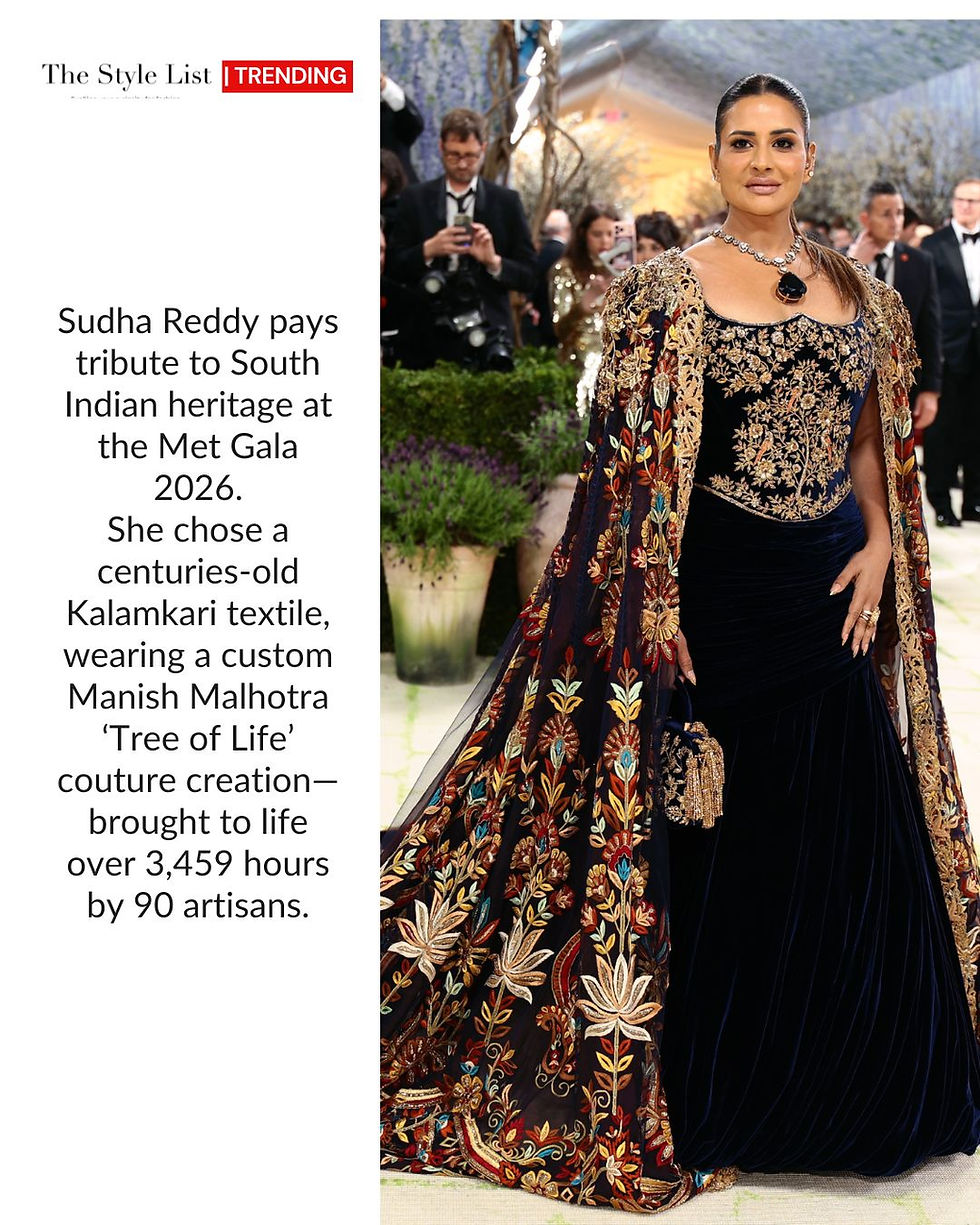
Sudha Reddy paid tribute to South Indian heritage at the Met Gala 2026 in a custom Manish Malhotra couture look inspired by the traditional Kalamkari art form.
Taking over 3,400 hours and crafted by 90 artisans, the ensemble reimagined the centuries-old textile through a modern, sculptural lens. The look centred around the “Tree of Life” motif, brought alive through intricate hand techniques like zardozi, marodi, and resham embroidery, layered across velvet, silk, and tulle. Antique gold zari work flowed across the outfit, while detailed motifs of birds, florals, and nature were carefully embroidered to create depth and movement. The structured corset added shape, the flowing skirt brought drama, and the sheer tulle cape softened the entire look. A sculpted metal vine installation at the back—crafted in brass, copper, and silver—added a striking, almost art-like finish.
She paired the look with a statement diamond necklace, bold rings, and a clutch, keeping the overall feel grand and detailed. Finished with a sleek bun and smokey eyes, the look beautifully blended traditional Indian craft with modern couture drama.
Mona Patel custom Dolce & Gabbana Alta Moda

Soft, muted and elegant, Mona Patel in custom Dolce & Gabbana Alta Moda wore a look inspired by Leonardo da Vinci and the human body. The outer layer, called the “Veil of Genius,” felt light and dreamy, like sketches coming to life with hints of the Vitruvian Man and the Mona Lisa. Underneath was an ivory gown shaped like the body, hand-pleated chiffon created the effect of muscles, a silk spine ran down the back, gold details traced the circulatory system, and diamonds were placed like neural pathways along the sleeves. Together, the look moved from idea to body, mixing art, science and couture in a very simple yet striking way.
Diya Mehta Jatia wore a Mayyur Girotra, her gown used Kanjeevaram sari fabric and Bengal’s shola craft, showing Indian textiles in a new way.
If there’s one look we felt could easily be worn beyond the Met Gala 2026, it’s this, and Mayyur Girotra really nailed it. Diya Mehta Jatia wore a gown by the designer that gave Indian textiles a fresh, modern spin. The look used a gold and silver Kanjeevaram sari as its base, layered with delicate shola work from Bengal —a craft that’s usually seen in festive décor and ceremonial pieces. Here, it was reimagined into fashion. The shola detailing, shaped slowly over weeks by skilled Bengali artisans, added softness and texture without making the outfit feel bulky. It gave the gown a light, almost airy feel, which worked beautifully on the red carpet.
Shola is not your usual fabric—it comes from a soft, sponge-like plant that grows in the marshlands of West Bengal. It’s incredibly light and fragile, which means it has to be handled with extreme care.
The artisans who work with shola are often from families that have been practising this craft for generations. They hand-carve the material using simple tools, shaping it into delicate forms—flowers, patterns, and motifs that almost look like ivory but feel feather-light. It’s the kind of work that takes patience and precision, because one wrong cut can break the entire piece. Traditionally, you’ll see shola in Durga Puja decorations, bridal headgear, or ceremonial pieces—not on a red carpet. That’s what makes this look special.
What makes this look even more interesting is how it connects to the designer’s larger vision. Mayyur Girotra has been working with heritage textiles—from Kutch weaves and Ikat to Batik and Bandhani—and turning them into modern pieces you can actually wear today. This gown felt like a natural extension of that idea. It didn’t try too hard to be dramatic, but still carried depth and meaning.
And while it may look simple at first glance, there’s a lot happening behind the scenes.
Princess Gauravi Kumari and Sawai Padmanabh Singh in Prabal Gurung - A royal moment, inspired by Maharani Gayatri Devi and Jaipur’s craft legacy.
It’s clear that India’s royalty made a strong impression at the Met Gala 2026. Gauravi Kumari brought back the timeless elegance of Maharani Gayatri Devi to the red carpet, while Sawai Padmanabh Singh honoured Jaipur’s rich legacy with a look rooted in tradition.
As highlighted by Vogue India's Instagram post, Gauravi’s look drew directly from her grandmother’s signature style—think soft chiffon saris and classic pearls that still feel relevant today. For Pacho, the focus was the Phulghar coat, created with Prabal Gurung and brought to life in Jaipur by artisans Yash and Ashima Tholia. Made in deep velvet, quilted with cotton, and crafted over 600 hours, the piece featured detailed aari, zardozi, dabka, and resham embroidery—blending heritage craftsmanship with modern design.


Comments